
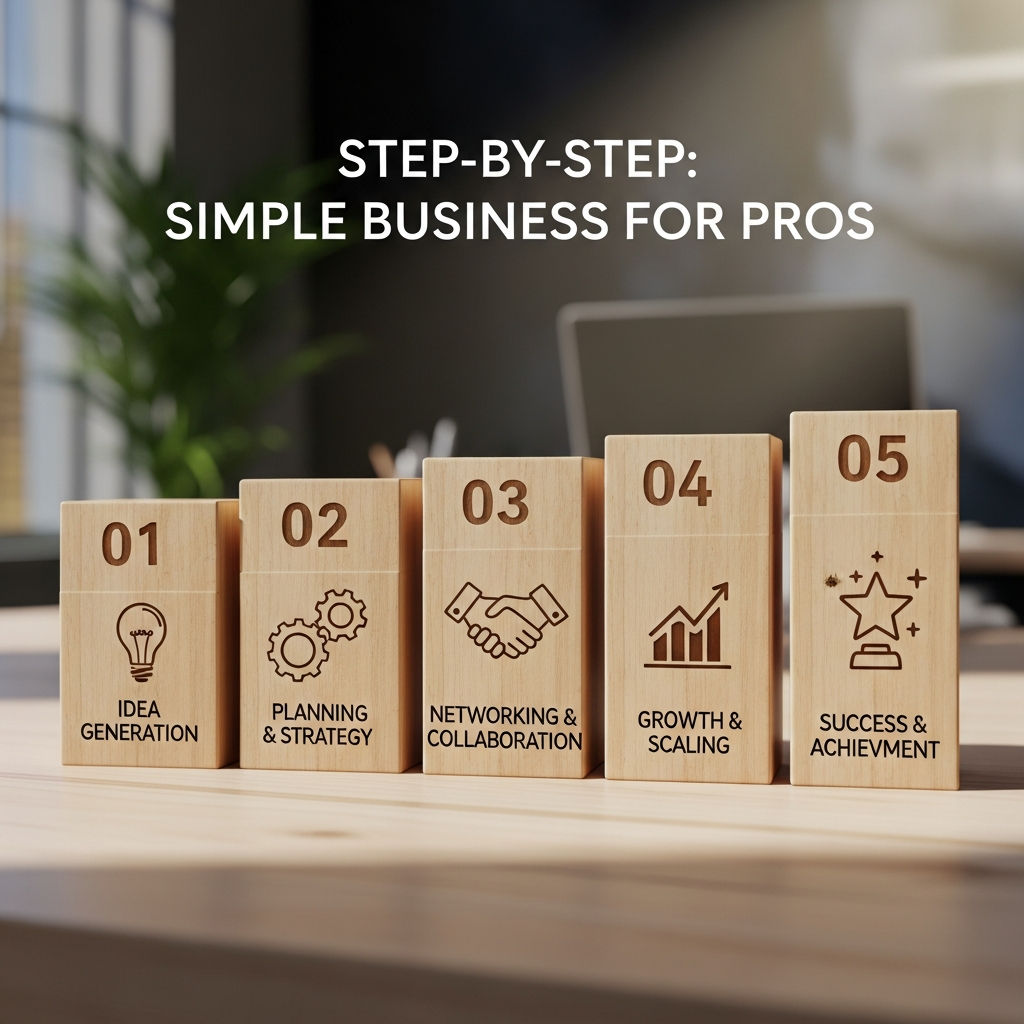
Step-by-Step: Simple Business for Pros – Leverage Your Expertise for Profit
As a seasoned professional, you’ve dedicated years to honing your skills, building a network, and accumulating invaluable experience. But what if you could leverage that expertise beyond your current role? Many professionals are discovering the power of launching a “simple business”—a venture designed to capitalize on their strengths without the typical complexities, colossal overheads, or exhaustive time commitments of a traditional startup.
This comprehensive guide is tailored for you: the professional seeking to transform their knowledge into a profitable, manageable, and deeply satisfying enterprise. We’ll walk through a pragmatic, step-by-step approach to building a simple business that aligns with your professional prowess and personal aspirations.
Why Professionals Are Primed for Simple Businesses
You already possess critical advantages that most nascent entrepreneurs only dream of:
- Existing Skill Set: Deep industry knowledge, specialized technical skills, and proven problem-solving abilities.
- Professional Network: Contacts built over years—potential clients, collaborators, and referrers.
- Discipline & Work Ethic: The ability to manage projects, meet deadlines, and deliver quality results.
- Financial Stability: Often, less pressure to generate immediate, massive revenue, allowing for a more strategic, lean launch.
- Credibility: Your professional background instantly lends authority and trust.
By focusing on simplicity, you avoid common startup pitfalls and build a business that serves your life, rather than consumes it.
Step 1: Identify Your “Simple” Niche & Leverage Your Expertise
The first step is introspection and strategic mapping. What does “simple” mean for your unique skill set?
What is “Simple” for YOU?
Simplicity isn’t about avoiding hard work; it’s about eliminating unnecessary complexity. For a professional, simplicity often means:
- High-Value, Low-Overhead Services: Consulting, coaching, specialized freelancing, digital products.
- Leveraging Existing Skills: Not learning a brand new trade, but repackaging what you already do well.
- Targeting a Specific Problem: Solving a defined pain point for a clear audience.
Audit Your Expertise & Passions
Grab a pen and paper (or open a document). List:
- Your Core Professional Skills: What are you consistently praised for at work? What problems do you solve effortlessly for others? (e.g., project management, data analysis, content strategy, software development, financial planning, legal advice).
- Your Industry Knowledge: What unique insights do you have about your sector?
- Your “Hidden” Talents & Passions: Are you an excellent presenter? A gifted mentor? Do you love organizing? Sometimes the simplest businesses stem from passions you didn’t think were marketable.
Look for intersections where your skills, industry insights, and passions overlap. This is your sweet spot.
Market Research – The Lean Way
You don’t need a multi-million dollar study. Your research should be pragmatic:
- Identify Your Ideal Client: Who would benefit most from your specific expertise? What are their biggest challenges?
- Validate Your Idea: Talk to potential clients. Ask about their pain points. Listen more than you talk. Do they express a need for what you offer? Look at online forums, LinkedIn groups, and industry publications to see what questions are being asked.
- Scout Competitors: Who else is serving this niche? What are they doing well? Where are their gaps? How can you differentiate based on your unique experience?
Brainstorm Simple Business Models
Consider models that directly utilize your existing knowledge:
- Consulting/Advisory: Offering strategic guidance on a specific problem (e.g., fractional CMO, cybersecurity consultant for small businesses).
- Coaching: Guiding individuals or teams to achieve specific professional goals (e.g., leadership coach, career transition coach).
- Specialized Freelancing: Providing a highly focused service (e.g., technical writer for SaaS companies, advanced Excel specialist, niche legal document preparation).
- Digital Products: Creating and selling courses, templates, e-books, or tools based on your expertise (e.g., an online course on advanced pivot tables for finance professionals).
- Done-For-You Services: Executing a specific task that leverages your specialized skill set.
Step 2: Define Your Minimal Viable Offer (MVO)
Resist the urge to build a comprehensive suite of services. Start with the absolute minimum to test the waters.
Focus on One Core Service/Product
Your MVO should be the smallest possible offering that delivers significant value to your target client. For example, instead of offering “full-service marketing,” you might offer “1-day LinkedIn strategy audit for B2B executives.”
- Clear Deliverables: What exactly will the client receive?
- Specific Outcome: What problem does it solve, or what benefit does it provide?
- Time-Bound (Optional but Recommended): Can it be delivered in a defined period?
Package & Price It
How will you present your MVO?
- Value-Based Pricing: As a professional, your time and expertise are valuable. Price based on the value you provide, not just hours. Research industry rates for similar high-level services.
- Simple Structure: One-off project, retainer, or clear hourly rate (if project-based isn’t suitable).
- Contract/Agreement: A simple, clear agreement outlining scope, deliverables, payment terms.
Build Your Initial Credibility Kit
You don’t need an elaborate setup to start. Focus on essentials:

- Professional Online Presence: Optimize your LinkedIn profile to reflect your new venture. A simple landing page or one-page website explaining your MVO and who you help is often sufficient.
- Elevator Pitch: A concise, compelling statement about what you do and who you help.
- Social Proof: Gather testimonials from past colleagues, employers (if appropriate), or initial clients. Focus on outcomes and your professionalism.
Step 3: Lean Marketing & Sales for Pros
Leverage your existing network and professional channels first. Forget expensive ad campaigns initially.
Leverage Your Existing Network
This is your goldmine. Start with warm outreach:
- Inform Contacts: Let friends, former colleagues, and industry connections know about your new venture and who you’re looking to help.
- Strategic Conversations: Don’t just sell. Ask open-ended questions about challenges they or their organizations face. Offer insights.
- Ask for Referrals: Clearly state who your ideal client is and ask if they know anyone who fits the description.
Content Marketing with Authority
As a professional, you’re an authority. Share your knowledge:
- LinkedIn Articles/Posts: Share insights, case studies (anonymized), or thought leadership on topics relevant to your MVO.
- Guest Posts/Podcasts: Offer to contribute to industry blogs or podcasts to reach a wider, targeted audience.
- Focused Blog: If you enjoy writing, a simple blog can establish your expertise and attract organic search traffic.
Simple Online Presence & SEO Basics
Even for a simple business, visibility is key:
- Optimize for Search: Use keywords related to your MVO on your website, LinkedIn profile, and content. (e.g., “fractional CMO for startups,” “cybersecurity consulting small business”).
- Choose 1-2 Social Platforms: Focus your efforts where your ideal clients spend their time (likely LinkedIn, possibly Twitter or an industry-specific forum).
- Email List (Early On): Even a small list allows you to nurture relationships and share valuable content directly.
Step 4: Streamline Operations & Automate
Keep your business agile and efficient from day one.
Essential Tools Only
Avoid software bloat. Start with the absolute necessities:
- Scheduling: Calendly, Acuity Scheduling.
- Communication: Zoom, Google Meet.
- Project Management: Trello, Asana (free tiers are often sufficient).
- Invoicing & Payments: Stripe, PayPal, QuickBooks Self-Employed.
- Simple CRM: HubSpot (free tier), Notion, or even a robust spreadsheet.
Develop Standard Operating Procedures (SOPs)
Even for a business of one, documenting your processes saves time and ensures consistency:
- Client Onboarding: Steps from first contact to signed contract.
- Service Delivery: How you complete your MVO for each client.
- Client Offboarding/Follow-up: How you ensure satisfaction and encourage referrals.
Outsource Wisely (When Ready)
Once you have a steady stream of clients, consider delegating non-core tasks:
- Administrative Assistant: For scheduling, email management, light research.
- Bookkeeping: To manage finances and tax preparation.
- Technical Support: If your business relies heavily on specific software or platforms.
Step 5: Growth Through Iteration & Client Feedback
A simple business thrives on adaptability and continuous improvement.
Listen Actively to Client Feedback
Every client interaction is an opportunity to refine your offer:
- Post-Project Surveys: Ask what worked, what didn’t, and what more they needed.
- Informal Conversations: Engage clients in open dialogue about their evolving needs.
- Observe Patterns: Are clients consistently asking for the same additional service?
Refine Your Offer
Based on feedback, pivot or enhance your MVO:
- Adjust Pricing: Are you undervalued? Are clients balking at your rates?
- Add/Modify Services: If there’s a clear, recurring demand for a complementary service, consider adding it (but keep it simple!).
- Improve Processes: Streamline your delivery based on client suggestions.
Scale Smart, Not Hard
Growth for a simple business doesn’t always mean hiring a huge team. Consider:
- Group Coaching/Workshops: Leverage your time by serving multiple clients simultaneously.
- Templated Solutions: Develop reusable assets (templates, checklists) that you can sell or use to speed up service delivery.
- Online Courses: Package your expertise into a digital course to reach a wider audience.
Conclusion
Launching a simple business as a professional isn’t about starting small; it’s about starting smart. It’s about recognizing the immense value you’ve already cultivated and finding the most direct, efficient path to share that value with the world, on your terms. By methodically identifying your niche, crafting a minimal viable offer, leveraging your professional network, streamlining operations, and continuously iterating, you can build a robust, fulfilling, and profitable enterprise. The journey begins with that first, deliberate step. What expertise will you unleash today?